.png)
.png)
The Proxi Circuit as Seen by Impact in LSA
The Proxi Circuit as Seen by Impact in LSA
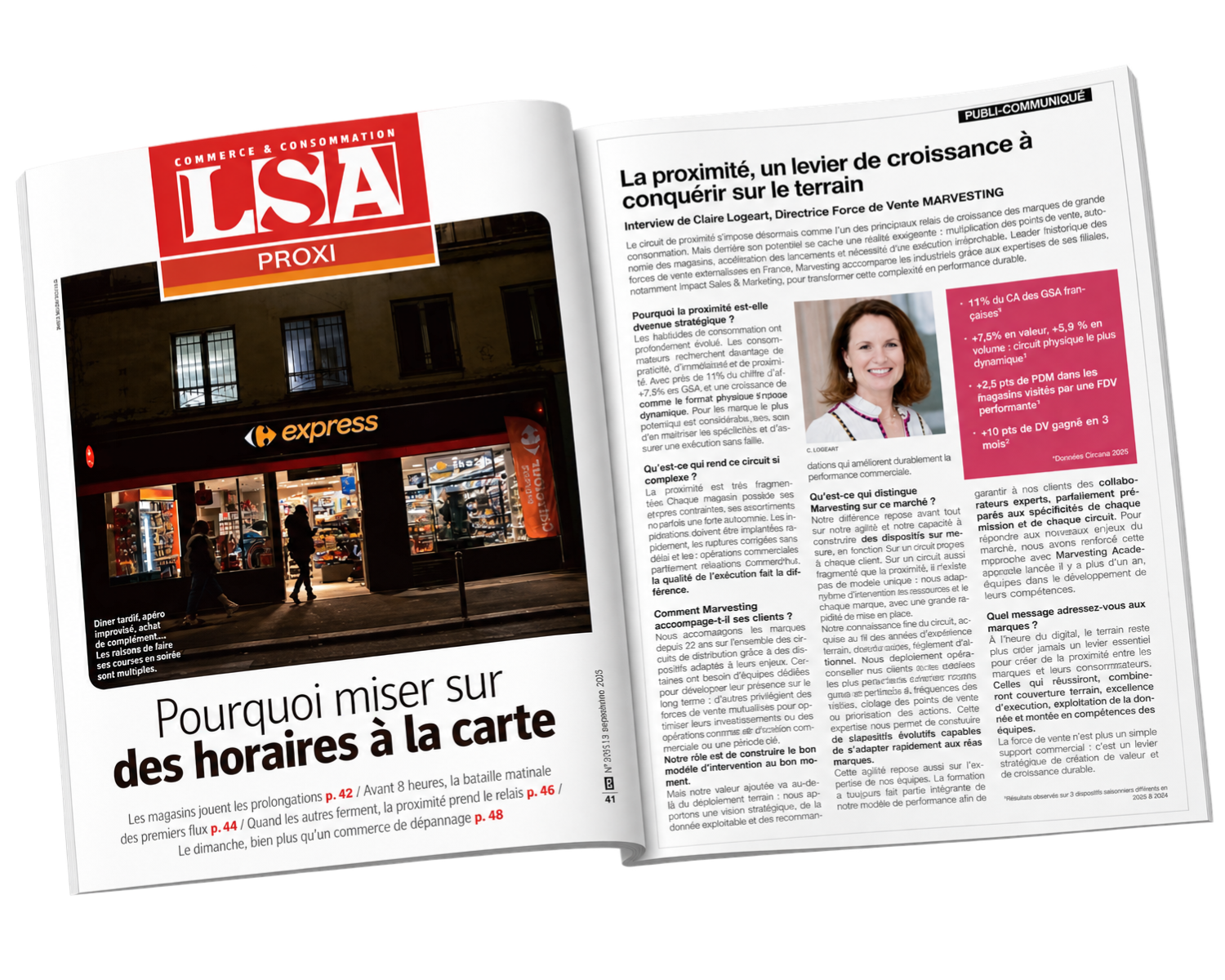
Local presence is emerging as a key driver of growth for brands. But how can brands succeed in such a fragmented and demanding market?
In its latest special issue dedicated to neighborhood retail,LSA features Claire Logeart, Director of Sales for France, to analyze trends in this channel and the strategies that enable brands to turn its potential into sales performance.
This statement highlights one key point in particular: given the growing number of retail locations, the autonomy of stores, and the diversity of product assortments, the quality of on-the-ground execution is more critical than ever.
Local Markets: A Strategic Approach Analyzed in LSA
Consumer habits are shifting toward greater convenience, immediacy, and proximity.
This trend is directly reflected in the figures: the local retail sector now accounts for nearly 11% of the revenue of French hypermarkets and has grown by 7.5% in value and 5.9% in volume.
It has thus established itself as the most dynamic physical circuit.
Significant potential for brands, but one that comes with many unique challenges.
As Claire Logeart explains in LSA, the local retail sector is a particularly fragmented market. Each store has its own constraints, product assortments, and, in some cases, a high degree of autonomy.
Innovations must be implemented quickly, disruptions addressed, and business operations properly managed.
In this environment, there is no single model: the on-the-ground approach must adapt to the realities of each brand and each network.
Sales Force: Building the Right Structure at the Right Time
This is one of the key issues highlighted in this presentation: not all brands have the same goals or the same on-the-ground needs.
Depending on the situation, several models may be considered.
A dedicated sales force can help build a brand's presence over the long term and foster ongoing relationships with retail locations.
A shared sales force is better suited to the goal of optimizing investments while ensuring adequate field coverage.
Finally, targeted campaigns allow resources to be concentrated over a strategic period—for example, to support a product launch, a sales campaign, or a seasonal highlight.
The challenge, therefore, is not only to identify the right intervention model at the right time, but also to adapt it based on observed performance.
Expertise that goes beyond field deployment
The article in LSA also highlights a significant shift in the industry: today, the performance of a sales force is no longer measured solely by the number of visits made.
Targeting retail locations, the frequency of visits, team configuration, and the prioritization of actions all directly contribute to the effectiveness of the program.
Data therefore plays a crucial role.
Combined with the insights of field teams, it helps identify opportunities, better allocate resources, and adjust actions based on results.
Field operations provide the data, and that data, in turn, enables us to better manage field operations.
This synergy makes it possible to shift from a focus on coverage to a genuine focus on measurable sales performance.
Tangible Results at the Point of Sale
This approach is directly reflected in the observed performance.
In stores visited by a high-performing sales force, results show a gain of 2.5 percentage points in market share¹.
In three different seasonal campaigns conducted in 2025 and 2026, up to +10 digital distribution points were also gained in just three months.
These results illustrate the importance of combining strategy, circuit knowledge, and excellent execution to turn every field operation into a growth opportunity.
Fieldwork, data, and skills: the pillars of tomorrow's performance
While digital tools and data now make it possible to refine the management of these programs, human expertise remains at the heart of their performance.
Training and skill development for teams are therefore another key factor in ensuring that employees are prepared for the specific requirements of each assignment and each route.
A belief summarized by Claire Logeart in LSA:
"In the digital age, the brands that will succeed are those capable of combining field coverage, operational excellence, data analytics, and team development."
At Impact Sales & Marketing, this vision guides the development of strategies tailored to the specific challenges of each brand, drawing on hands-on expertise, data, and team training.
As this article in LSA points out, the sales force is no longer merely a sales support function: today, it is a true strategic driver of value creation and sustainable growth.